

Who knew you could dye alpaca wool with crushed bugs?
When I first scrolled through the itinerary for the G Adventures’ Inca Journey tour in Peru, one stop jumped out at me almost as much as Machu Picchu itself: The Ccaccaccollo Women's Weaving Co-op. With support from Planeterra – G Adventures non-profit partner – women in the Ccaccaccollo community are bringing back weaving traditions that had been lost over the previous generations.
We all know tourism is a massive global industry, but we have to question how much local communities actually benefit from it. That’s where this project stood out to me as a traveller. I was actually counting down the days until we visited this community in person. I’d only read brief descriptions and seen pictures of this place, so I didn’t really know what to expect, but I was so curious about it – and boy, was I amazed.
The art of Peruvian textiles: A behind the scenes look
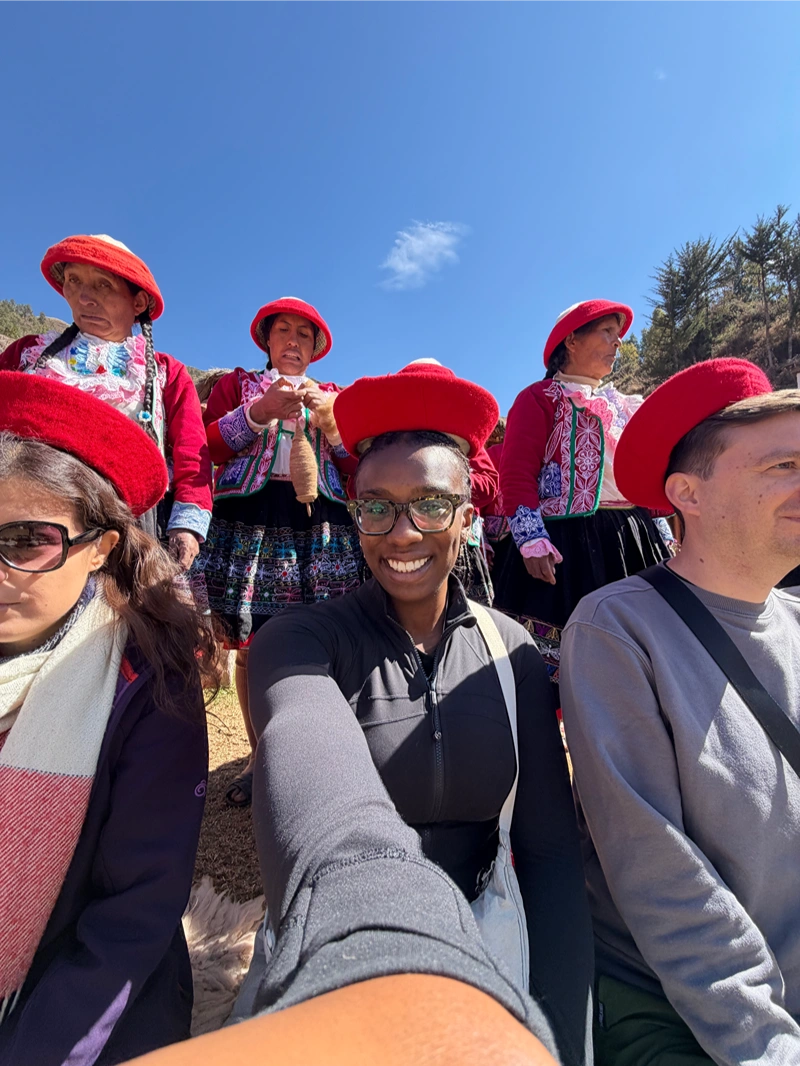
We pulled up to Ccaccaccollo, a small Indigenous Quechua community tucked away in the Sacred Valley. I watched each person in my group get off the bus before I stepped off. Everyone was greeted by one of the Ccaccaccollo women with a hug before our feet even fully stepped off the bus.
Immediately, I was reminded of my grandma with her embrace. There was something about that warmth and familiarity that instantly made me feel comfortable. It was at that moment that I knew this was going to be a one of a kind experience — like I had a vision about what the next two hours were going to be like.
 |
 |
 |
We started with a textile demonstration, and one of the women showed us how they clean freshly sheared alpaca wool by hand. Then it's time to spin the wool into a two-strand twist. And when I say they spin – I mean it never stops – like a yo-yo. You might think they only spin while sitting. Wrong! They spin while they're talking, laughing, walking – and even while they’re dancing.
It's so second-nature to them that their hands just keep moving on autopilot. I remember thinking, ‘Dang, I can't even fold laundry without getting distracted, and this woman is spinning perfect wool while chit chatting with her friend.’ Queens of multi-tasking. And then came the dyeing process.
Understanding natural dyeing traditions
They did something I did not expect. They dyed the wool with dried, crushed up cochineal insects. I’ve never heard of a cochineal insect before, and I can’t even pronounce it, unfortunately. What I do know though is that these tiny insects contain a natural pigment called carminic acid, which is what gives the dye its incredible colour. When other ingredients were added to it… yup, it changed colours!
She added a squeeze of lime, and the paste turned into a bright orange. Then she added mineral salt, and it changed colour again. I was so hung up on the women changing the colour the first time that I barely comprehended all the other natural ingredients she used to make about six or seven colours. It was incredible.
I was sitting there thinking, ‘How did they even discover this? How can one insect create basically the entire rainbow?’
It doesn’t end there though. Insects aren't the only things dyeing the alpaca wool. Ch'illca leaves, which are a native plant to Peru, can also be used to produce natural green dyes. The women made a mixture with the leaves and hot water, then steeped the wool for 45 minutes so the colour held and didn't bleed out.
 |
 |
 |
|
This whole textile demonstration was in Spanish, but our Chief Experience Officer (CEO) Gina Loayza, who was there every step of the way, translated everything – including their jokes – back to us.
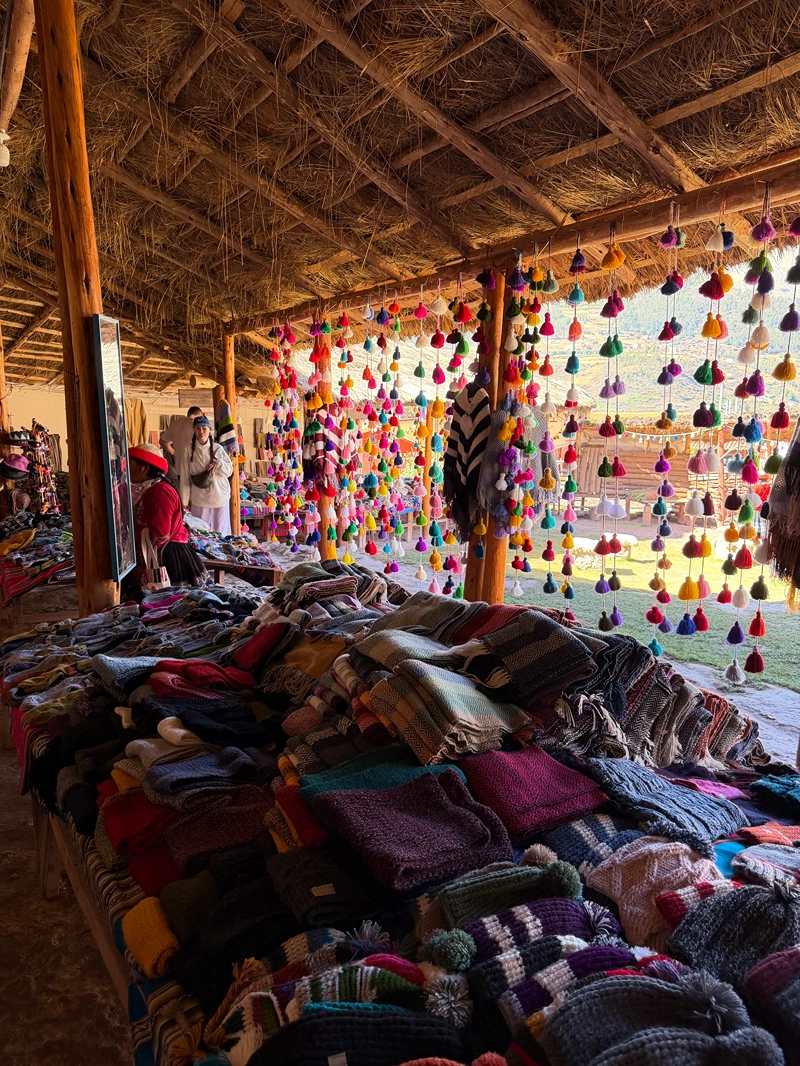
Not going to lie, during our weaving demonstration I kept eyeing the table of handmade products they had on display that we could purchase. Ponchos, hats, gloves, little stuffed alpacas, keychains – all of it made from the exact wool we'd just watched them spin and dye.
Beyond the souvenir: Why responsible travel matters in Peru
 |
 |
After witnessing the work that gets put into making the products firsthand, I started looking at those products a little differently. Something that looks like a simple hat or scarf sitting on a table actually starts with shearing, cleaning, spinning, dyeing, and weaving the wool by hand.
I’m not really a big souvenir shopper when travelling, but after watching the textile demonstration, and learning about how long it takes to get the wool made me appreciate the craft more. These didn't feel like souvenirs mass produced in a factory overseas. I told myself I was going to spend less money this trip because I only travelled with a 40L backpack – and barely had any room– but at that moment, I didn’t care. Each person in my group left with multiple Ccaccaccollo-made mementos in hand and a new found appreciation for Peruvian art and culture.
60 women currently work at this co-op, and once a month they count all the money and split it between themselves. They also save about 1 per cent of their monthly earnings to help people in the surrounding communities who need things like medical care, schooling, and supplies.
What made this experience stand out to me was realizing that my purchase wasn’t just about taking something home from Peru. The money goes directly back to the women who make these products and helps support their families and surrounding communities. This is why I love Planeterra partners and community tourism – it makes you think differently about the way you spend money while travelling.
I went to Ccaccaccollo expecting a nice photo op before Machu Picchu but instead, left with a completely different understanding of what it actually means for tourism to do something for local communities, instead of just passing through.
Read more stories like this:
How one traveller trained for Peru’s high-altitude Salkantay Trek to Machu Picchu
Beyond Machu Picchu: A photographer’s sensory journey through Peru


